
Blog Post Published on: June 22, 2026, by Gabkotech
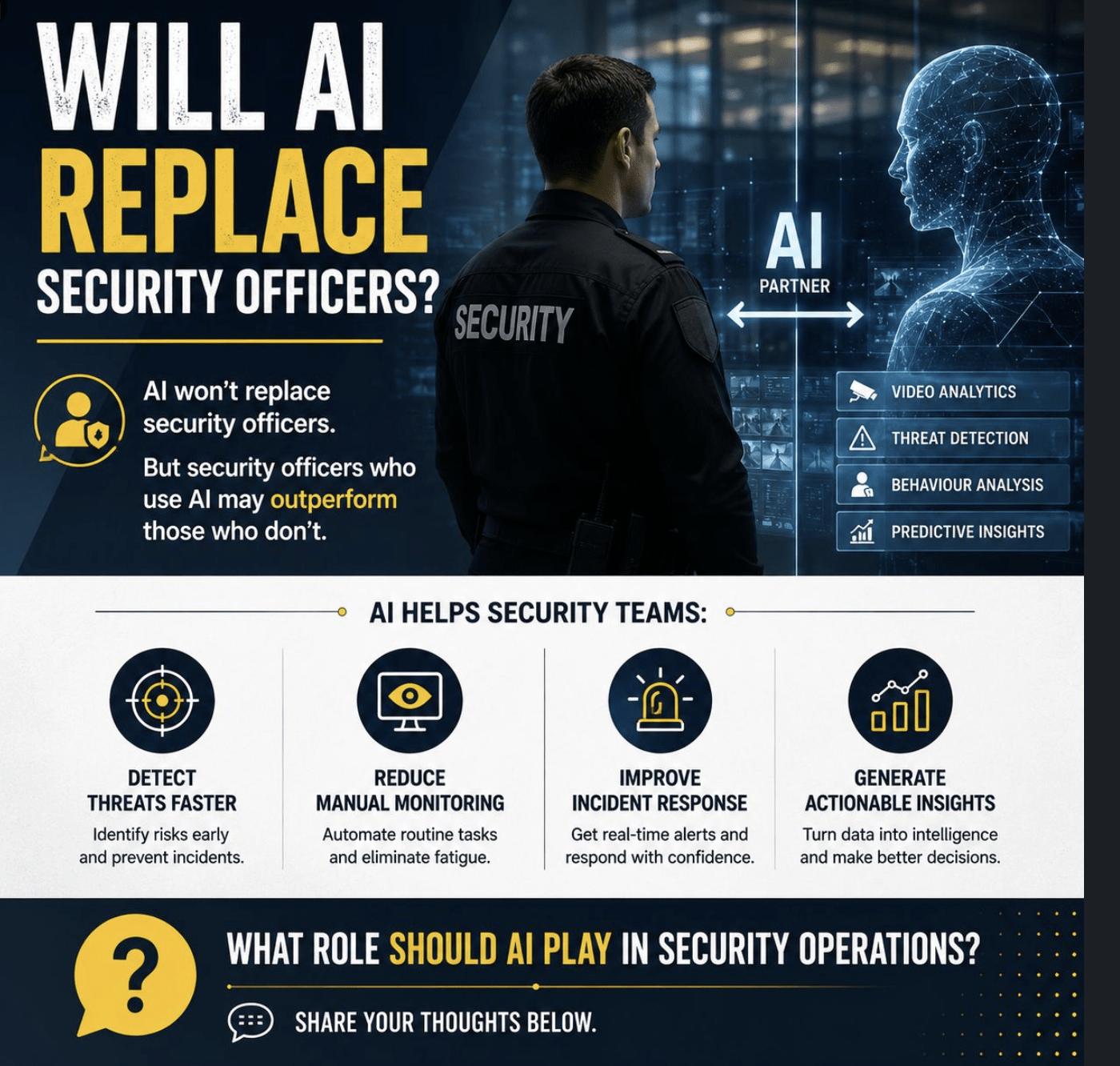
Artificial intelligence is changing how security operations are managed.
AI powered video analytics can monitor large volumes of footage, identify unusual activities, generate automated alerts and help security teams detect potential risks more quickly. Digital platforms can also organise incident information, analyse operational data and provide management with a clearer view across multiple locations.
This has led to an important question:
Will AI replace security officers?
The more realistic answer is that AI is unlikely to remove the need for human security personnel entirely. Instead, it is changing how security officers work.
AI can process information quickly and automate repetitive monitoring tasks. However, security officers still provide human judgement, communication, physical presence, situational awareness and the ability to manage complex or unexpected situations.
The future of security is therefore not simply human versus machine. It is increasingly about how security professionals and intelligent technology can work together.
Security operations have traditionally depended heavily on manpower.
Officers monitor CCTV screens, conduct patrols, manage access points, respond to incidents, prepare reports and communicate with occupants, visitors and management.
However, several operational pressures are encouraging organisations to adopt more technology:
AI can help organisations manage some of these demands without expecting one officer to continuously watch every camera, review every record or identify every operational pattern manually.
Gabkotech already positions AI and automation as tools that can reduce repetitive administrative work while allowing officers to concentrate on higher value responsibilities.
AI is particularly effective when it is used to process large volumes of information, detect patterns and generate alerts.
A human operator may be responsible for observing many CCTV feeds simultaneously. Maintaining complete attention across every screen for long periods can be difficult.
AI-powered video analytics can analyse video feeds continuously and alert operators when predefined activities or unusual events are detected.
Gabkotech’s Advanced Video Analytics system is designed to transform video footage into actionable security information. It supports functions such as intrusion detection, loitering alerts, facial recognition and crowd analysis, helping security teams improve situational awareness and accelerate their response.
AI systems can be configured to identify specific activities or conditions that may require attention.
Examples may include:
Once a possible event is detected, the system can notify a security operator for verification.
AI does not necessarily make the final decision. It helps direct the officer’s attention towards situations that may need human assessment.
Continuous manual monitoring requires significant concentration and manpower.
By using AI to identify selected events, security officers can spend less time passively watching screens and more time:
This changes the officer’s role from passive observation towards more active assessment and response.
AI can also analyse operational data beyond live video.
For example, security managers may identify:
The Gabkotech Security Integrated Management System (GSIMS) combines centralised monitoring with AI-powered analytics to analyse patterns, support earlier risk detection and provide management with more useful operational information.
Although AI can process information quickly, security work involves more than detecting an event.
Security incidents are not always straightforward.
An action that looks suspicious in one situation may be harmless in another. Officers must consider the wider context, assess the people involved and determine the appropriate response.
AI may flag an event, but a trained person is often needed to evaluate what it means.
Security officers regularly interact with visitors, contractors, occupants, employees and members of the public.
They may need to:
These interactions require empathy, flexibility and communication skills that cannot be replaced easily by automated monitoring.
echnology can detect and communicate an event, but it cannot always provide a physical response.
A trained officer may still be required to:
A visible security presence may also provide reassurance and discourage unwanted behaviour.
AI generally performs best when it has clearly defined data and detection rules.
Real-world incidents may involve unclear information, conflicting priorities or rapidly changing conditions. Human officers can adapt their approach when an event does not follow a predictable pattern.
The role of the security officer is likely to become increasingly technology-enabled.
Instead of relying mainly on manual observation and paperwork, future security personnel may work with:
The iREP AI Security and Facility Management platform is positioned as a central intelligence environment that connects AI-driven incident reporting, workforce monitoring and smart analytics with existing systems such as video surveillance, access control and IoT devices.
The officer does not disappear from this model. The officer becomes better informed, more connected and better equipped to respond.
AI can review information continuously and highlight possible risks without waiting for an operator to notice them manually.
This enables security personnel to examine potential threats earlier.
Instead of monitoring every feed with the same level of attention, operators can prioritise cameras, sites or situations where the system has detected unusual activity.
When an alert is verified, digital workflows can help officers report and escalate the incident immediately.
The iREP Incident Report System allows authorised security or facility personnel to submit reports through mobile devices or dashboards, attach photographs and videos, assign follow-up actions and monitor resolution status. It can also connect with iREP Security and GSIMS for a more unified workflow.
Paper reports and informal messages can result in incomplete, inconsistent or delayed information.
Digital reporting allows details such as the reporting time, location, evidence, category and follow-up status to be retained in a centralised record.
A security manager overseeing several locations cannot physically observe every site at the same time.
The iREP Security Management System centralises key security workflows, including incident reporting, patrol management, emergency alerts, attendance and supervisory inspections. Its AI-supported capabilities can also help teams identify and respond to potential risks more proactively.
Physical patrols continue to play an important role because they allow officers to observe conditions that may not be visible through fixed cameras.
However, technology can make patrols more accountable and better targeted.
The iREP Clocking and Patrolling System allows patrol activities to be recorded digitally and can operate alongside visitor-management, emergency-alert and facility-monitoring systems.
When patrol information is combined with video analytics and incident data, management can identify:
AI and data analytics can help determine where human attention is most valuable, while officers continue to provide the physical inspection and judgement.
A command centre brings together information from different sites, cameras and operational systems.
Without automation, command-centre operators may face large quantities of information and alarms. AI can help organise this information and prioritise events that may require attention.
GSIMS supports centralised command-centre operations, video monitoring, analytics and audit records. Its AI-powered data analytics are intended to identify patterns and assist with early threat detection.
A human operator can then:
This demonstrates the partnership between technology and people: AI identifies and prioritises information, while officers interpret and act upon it.
AI and automation can support emergency response by helping information move more quickly between the people involved.
For example, a detected event may trigger an alert, which can then be verified by an operator and escalated to the relevant personnel.
The iREP Emergency Alert System can support faster communication by sending emergency information and response instructions to relevant personnel.
However, automated communication should operate alongside clear procedures, trained personnel and appropriate human oversight.
Technology can accelerate the flow of information, but people remain responsible for assessing the situation and coordinating the response.
AI systems are not automatically correct in every situation.
They may produce false alarms, miss unfamiliar events or interpret an activity without understanding the full context.
Human oversight remains important for:
Organisations should therefore treat AI as a decision-support tool rather than an unquestionable decision-maker.
Security teams also require clear policies covering what the system monitors, who can access the information and how alerts should be reviewed.
As security operations become more digital, officers may need to develop skills beyond traditional guarding duties.
Officers should be comfortable using mobile reporting applications, dashboards, patrol systems and communication tools.
Officers must understand how to review AI-generated alerts and distinguish genuine concerns from false alarms.
Security personnel may increasingly use operational information to identify patterns and explain site performance.
As routine tasks become automated, human interaction, investigation, coordination and reporting become even more important.
Security technology will continue to evolve. Officers and supervisors will need ongoing training to use new systems effectively and responsibly.
AI can generate alerts and recommendations, but there should still be a clear record of how people responded.
Digital security workflows should show:
The iREP Security Supervisory Check System can support digital inspections and operational accountability by allowing supervisory activities to be recorded and monitored.
Following a significant incident, the iREP After Action Review System can help teams document observations, identify root causes and record recommendations for future improvement. Gabkotech describes the system as supporting post-incident learning across security, facility-management and building-management workflows.
The strongest approach is not to replace all security officers with technology.
A well-designed operation allows technology to handle repetitive processing while security professionals focus on judgement, response and human interaction.
AI may reduce the amount of manual monitoring and administrative work required in some security environments.
Certain duties may be redesigned, consolidated or performed remotely. Security organisations may also be able to manage more locations through centralised command centres and technology-assisted workflows.
However, complete replacement is unlikely across most physical security environments because buildings and public spaces still require human judgement, communication, intervention and accountability.
A more realistic future is:
Security officers who learn to use AI and digital systems may become more productive and valuable than those who rely entirely on manual methods.
The key question should not only be:
Will AI replace security officers?
A more useful question is:
How can AI help security officers protect people and property more effectively?
AI can detect, organise, analyse and alert.
Security professionals can interpret, communicate, respond and make responsible decisions.
When the two work together, organisations can achieve:
The future security officer is not replaced by technology. The future security officer is supported by technology.
Gabkotech Innovations provides AI-enabled and digital security solutions that help organisations strengthen monitoring, incident reporting, patrol accountability and centralised operational visibility.
Explore how Advanced Video Analytics, GSIMS, iREP AI and the iREP Security Management System can support a more intelligent and connected security operation.



















26 Sin Ming Lane, #05-127 Midview City, Singapore (573971)
No. 47A, Jalan Indah 16/12, Taman Bukit Indah, 79100, Iskandar Puteri, Johor