
Blog Post Published on: June 29, 2026, by Gabkotech
Every organisation faces pressure to manage costs.
Rising manpower expenses, energy consumption, maintenance costs, administrative work and inefficient resource deployment can affect profitability and long term sustainability.
However, reducing costs without understanding the operational impact can create new problems.
Reducing manpower without improving workflows may increase workloads. Delaying maintenance may result in more expensive equipment failures. Cutting service activities without reviewing operational data may affect response times, customer satisfaction and service quality.
Cost reduction should therefore not be treated simply as spending less.
The objective should be to remove waste, improve productivity and use resources more effectively while protecting the service outcomes that matter to customers, occupants and stakeholders.
Smart cost optimisation brings together four important elements:
When these elements work together, organisations may be able to lower operating costs while maintaining or even improving service delivery.
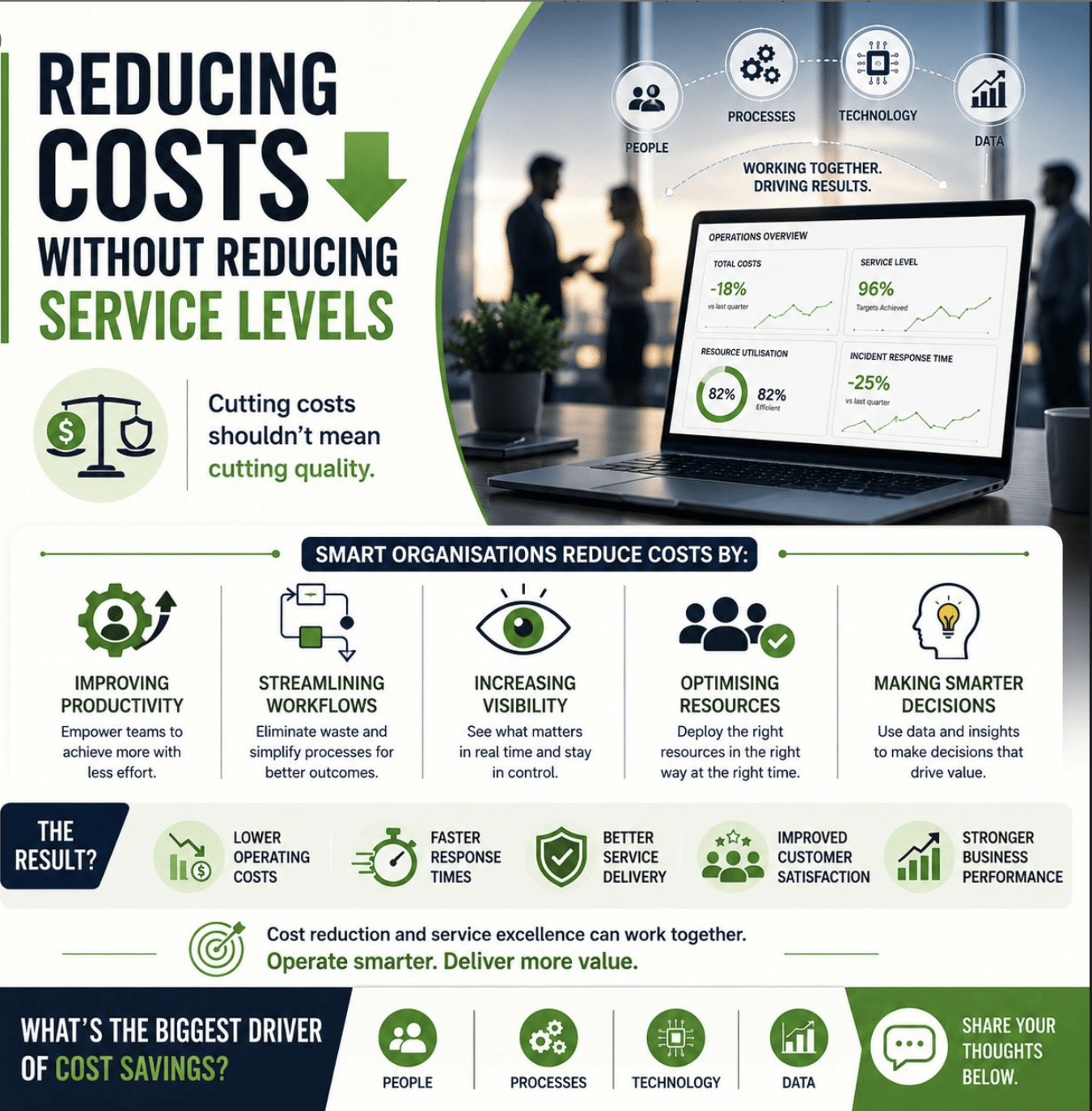
Traditional cost cutting often focuses on reducing budgets, manpower or service frequency.
These actions may provide short-term savings, but they can also create hidden costs.
For example:
Sustainable cost optimisation takes a different approach.
Instead of asking:
“What can we remove?”
Management should ask:
“Which activities create value, which activities create waste and how can we deliver the required service more efficiently?”
An Integrated Facility Management (IFM) approach brings maintenance, security, energy management, space management and other facility functions into a more coordinated operating model. This can reduce duplicated work, improve resource use and support more consistent building performance.
Not all operating costs are clearly visible in financial reports.
Some costs are created by inefficient daily processes.
Employees may spend significant time:
Each task may appear small, but repeated manual work can consume many hours across an organisation.
When management receives information late, problems may become more expensive to resolve.
A maintenance fault that could have been addressed early may develop into equipment downtime. A delayed incident report may require more investigation and follow up.
Waiting for equipment to fail may lead to:
Without visibility of workloads and operational demand, organisations may deploy too many resources in some areas and too few in others.
When security, facilities, maintenance and workforce information are managed separately, employees may duplicate work or spend unnecessary time coordinating updates.
Improving productivity does not mean asking employees to work continuously or complete an unreasonable number of tasks.
It means giving people the information, processes and tools needed to perform their responsibilities more efficiently.
Organisations can improve productivity by:
The iREP Workforce Management System supports workforce scheduling, tracking and compliance while helping organisations improve productivity, operational efficiency and resource utilisation.
Technology should reduce unnecessary work so employees can spend more time on activities that require human judgement, communication and service delivery.
A workflow describes how a task moves from reporting to completion.
For example, a facility issue may involve:
When these steps are managed through telephone calls, emails, paper forms and messaging groups, information may be missed or duplicated.
Digital workflows can provide clearer visibility of:
The iREP Facility Management System centralises facility operations and supports maintenance scheduling, asset tracking, energy monitoring, real-time alerts and operational reporting. These capabilities can help organisations reduce manual work and improve operational efficiency.
Organisations cannot manage costs effectively if they cannot see how resources are being used.
Operational visibility helps management understand:
Real-time dashboards can reduce the time managers spend collecting updates from different departments.
However, the purpose of a dashboard is not simply to display more information.
It should help management answer practical questions:
Where are costs increasing?
Which problems occur repeatedly?
Which tasks are creating delays?
Where can resources be used more effectively?
Are cost-saving measures affecting service quality?
The iREP Facility Management System provides real-time monitoring and data-driven insights that can support resource allocation, maintenance planning and operational decision-making.
Cost reduction does not always require fewer resources.
Sometimes the organisation needs to use its existing resources more effectively.
Resource optimisation may include:
The objective is to deploy the appropriate resources at the appropriate location and time.
For facility operations, asset information can help management understand:
Effective resource optimisation supports cost control without automatically reducing service capacity.
Cost-saving decisions should be based on evidence rather than assumptions.
Operational data may help management identify:
The Smart Facility Management approach uses technologies such as IoT sensors, intelligent systems and cloud based platforms to support real-time monitoring, predictive maintenance and more efficient building operations.
Data does not replace management experience. It gives decision makers additional evidence to support better planning.
Facility services are often managed through separate teams, systems and contracts.
Maintenance may operate independently from security. Energy information may be reviewed separately from occupancy. Asset information may be stored in different spreadsheets.
This can create duplicated work and limit operational visibility.
An Integrated Facility Management solution brings multiple facility related services into a coordinated operating environment. Gabkotech describes IFM as an approach that consolidates maintenance, energy management, security and space management to improve efficiency, reduce operating costs and enhance building performance.
An integrated approach can help organisations:
Integration should not mean adding unnecessary complexity.
Its purpose is to make operations easier to understand, coordinate and improve.
Maintenance is an area where short-term cost cutting may create larger long term expenses.
Delaying routine maintenance may appear to reduce immediate spending, but equipment failures can result in:
Preventive and predictive maintenance can help organisations identify potential issues earlier.
The iREP Facility Management System supports automated maintenance scheduling, real-time monitoring, predictive maintenance and asset tracking. These functions can help facility teams reduce unplanned downtime and manage maintenance resources more effectively.
The aim is not to perform more maintenance than necessary.
It is to perform the appropriate maintenance before a manageable issue becomes a costly failure.
Energy is a significant operating expense for many buildings.
However, reducing energy use should not create uncomfortable or unsuitable environments for occupants.
Organisations can use operational information to identify:
Energy information becomes more useful when it is reviewed alongside occupancy, equipment and maintenance data.
The iREP Facility Management System includes energy monitoring capabilities designed to help facility managers identify usage patterns, optimise energy consumption and support sustainability objectives.
Inconsistent processes can create unnecessary costs.
When different employees or sites complete the same task differently, organisations may experience:
Standard operating procedures help employees understand what actions are required and how work should be completed.
The iREP SOP Management System provides a centralised digital environment for managing, updating and acknowledging operational procedures. It supports more consistent workflows across security, facilities management and building operations.
Standardisation should not prevent employees from exercising judgement. It provides a reliable foundation for routine work while allowing appropriate escalation when unusual situations arise.
Cost reduction should never be measured in isolation.
An organisation may reduce spending while unintentionally increasing response times, complaints or service disruptions.
Management should monitor both financial and service indicators.
Useful measures may include:
A successful cost saving initiative should improve efficiency without creating unacceptable reductions in service quality.
Technology should not be introduced simply because it is new.
It should address a clear operational problem.
Before adopting a new system, management should ask:
The iREP AI Security and Facility Management platform uses artificial intelligence and real-time operational data to support a more connected and efficient management environment.
The objective should not be to replace people unnecessarily.
Technology should help employees reduce repetitive work, access information more easily and focus on activities that create greater value.
Removing employees without changing inefficient workflows may increase workloads and reduce service quality.
Deferred maintenance can create larger repair expenses and longer service disruptions.
Technology may make an inefficient process faster without solving the underlying problem.
Some decisions reduce costs today but create higher expenses later.
Consider the total operational impact and long-term cost.
Frontline employees often understand where delays, repeated work and unnecessary processes occur.
Their feedback can help identify practical improvement opportunities.
Cost savings should be reviewed together with response times, service-level performance, quality and customer satisfaction.
Measure existing:
Look for:
Focus first on changes that can improve efficiency without negatively affecting service quality.
Remove unnecessary steps and clarify responsibilities.
Introduce tools that improve visibility, reduce manual work or support faster decisions.
Review whether savings are affecting:
Cost optimisation is not a one time exercise.
Review operational information regularly and adjust processes as conditions change.
Reducing costs does not have to mean reducing service quality.
Organisations can create sustainable savings by:
The goal is not simply to spend less.
It is to operate more intelligently and deliver greater value with the available resources.
When people, processes, technology and data work together, organisations can achieve:
Operate smarter. Deliver more value.
Is it:
The strongest results often come from aligning these elements rather than improving each one independently.
Gabkotech Innovations provides integrated facility, workforce and smart-building solutions designed to help organisations streamline operations, improve visibility, optimise resources and make more informed decisions.
Explore how Integrated Facility Management, the iREP Facility Management System, the iREP Workforce Management System and Smart Facility Management can support more efficient and sustainable operations.






26 Sin Ming Lane, #05-127 Midview City, Singapore (573971)
No. 47A, Jalan Indah 16/12, Taman Bukit Indah, 79100, Iskandar Puteri, Johor