
Blog Post Published on: July 1st, 2026, by Gabkotech
The most successful organisations do not improve performance simply by asking people to work harder.
They examine how work is performed, identify unnecessary delays and provide teams with better processes, information and technology.
Operational efficiency is about achieving better outcomes with the resources an organisation already has.
This may include:
However, operational efficiency should not mean placing greater pressure on employees or reducing resources without understanding the consequences.
Sustainable efficiency comes from aligning people, processes, technology and data so that work becomes clearer, faster and easier to manage.
Leading organisations focus on five important areas:
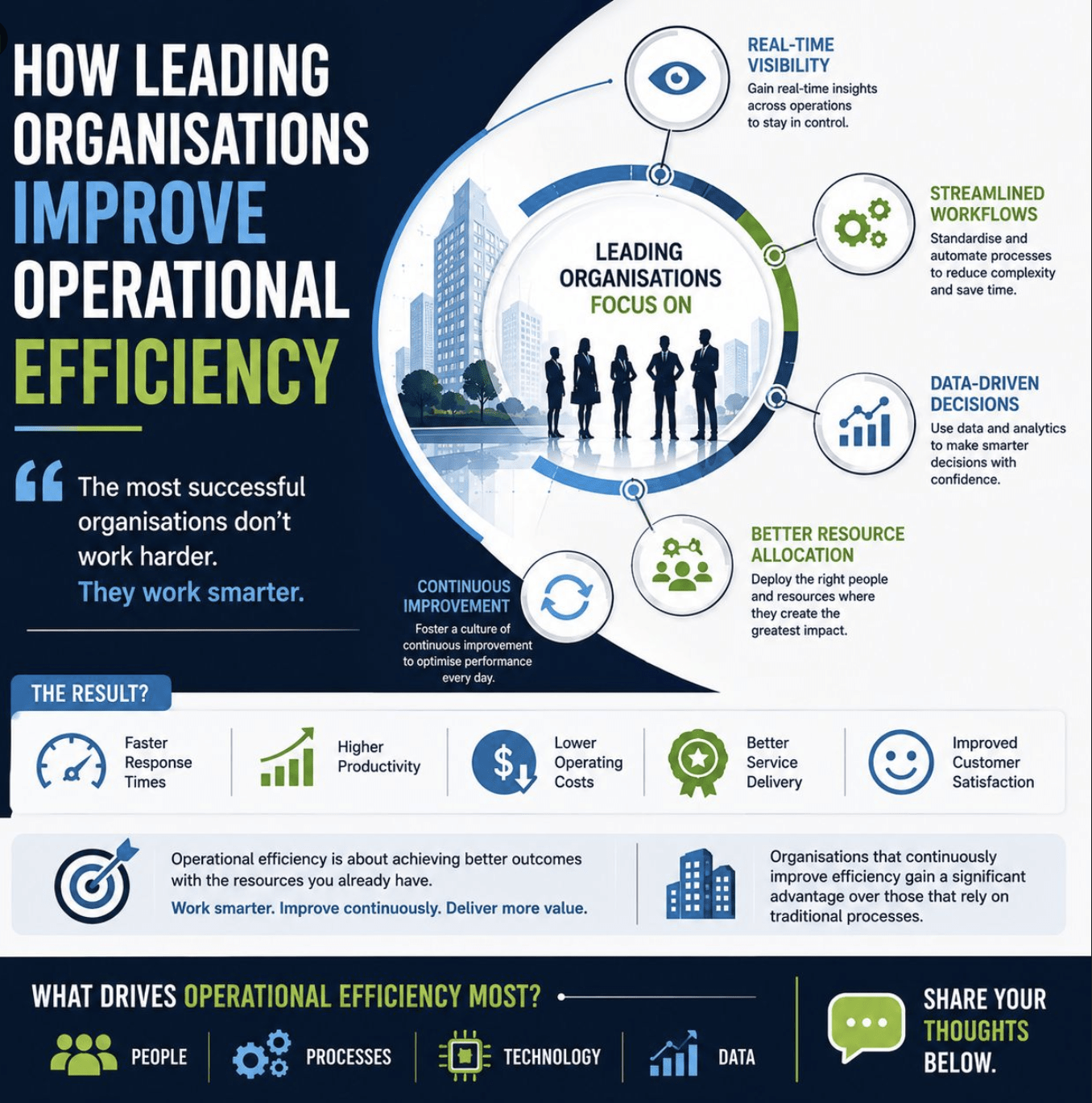
Operational efficiency is an organisation’s ability to use its available people, time, technology and resources effectively while maintaining the required level of service and quality.
An operationally efficient organisation aims to reduce:
At the same time, it aims to improve:
Operational efficiency is not simply about reducing expenses.
An organisation may lower its costs but become less efficient if service quality declines, employees become overloaded or operational risks increase.
True efficiency creates better outcomes without creating unnecessary pressure, complexity or risk.
Gabkotech’s iREP Facility Management System supports real-time monitoring, automated maintenance workflows, asset management and data-driven facility decisions. These capabilities can help facility teams streamline operations and improve the use of existing resources.
Organisations today face increasing operational demands.
Many are expected to:
Traditional processes may become difficult to scale as operations grow.
For example, an organisation may rely on:
These methods may work when operations are small. However, they can create delays, duplication and limited visibility as the number of employees, facilities or operational activities increases.
Digital systems can help organisations standardise workflows, automate routine activities and provide management with more timely operational information.
Organisations cannot improve what they cannot see.
When information is distributed across spreadsheets, paper records, emails and messaging groups, management may struggle to understand:
Real-time visibility provides management with more timely information across operations.
A central dashboard may display:
However, operational visibility is not about displaying as much information as possible.
The information should help management identify priorities and take appropriate action.
The iREP Facility Management System provides real-time operational information and analytics across facility activities, helping managers monitor assets, maintenance requirements and building performance through a more centralised environment.
A workflow describes how work moves from the initial request to completion.
For example, a facility maintenance workflow may involve:
When these activities are managed through separate telephone calls, emails, paper forms and messaging groups, information may be delayed or overlooked.
A digital workflow can provide clearer information about:
The Integrated Facility Management approach brings functions such as maintenance, security, energy management and asset tracking into a more coordinated operating environment. This can reduce duplicated work, improve collaboration and create greater visibility across facility operations.
Automation should not make processes more complicated.
Its purpose should be to reduce repetitive work, improve consistency and allow employees to focus on activities that require human experience, communication and judgement.
Leading organisations use operational information to understand performance and identify opportunities for improvement.
Operational data may help management answer questions such as:
Without reliable data, management may make decisions based mainly on assumptions or isolated feedback.
Data-driven decision-making provides additional evidence.
For example, if maintenance records show that the same equipment repeatedly requires repairs, management can evaluate whether preventive maintenance, process changes or asset replacement may provide a better long-term outcome.
The Smart Facility Management approach uses real-time monitoring, automated workflows, IoT information and intelligent analytics to support more informed facility-management decisions.
Data should support human judgement rather than replace it.
Management experience remains important when interpreting information, understanding context and deciding what action is appropriate.
Operational efficiency is not always about using fewer resources.
It is often about deploying existing resources more effectively.
Resources may include:
Poor resource allocation may result in:
Better operational information can help managers understand where resources are needed and how they should be deployed.
The iREP Workforce Management System supports workforce scheduling, task allocation and real-time workforce monitoring. It is designed to help organisations improve deployment, productivity and operational control.
The objective is to deploy the right people and resources to the right location at the right time.
Operational efficiency is not a one-time project.
Processes, technologies and customer expectations continue to change.
Leading organisations regularly review:
Continuous improvement does not always require major transformation.
Small improvements may include:
Small improvements can create meaningful results when applied consistently across many employees, sites and operational activities.
Gabkotech’s iREP After Action Review System supports structured learning by helping organisations record observations, identify lessons and develop recommendations following incidents, exercises and operational activities.
Technology alone does not create operational efficiency.
Employees understand many of the practical challenges that may not be visible in management reports.
Frontline employees often know:
Organisations should involve employees when reviewing and improving operational processes.
This can help management identify practical opportunities for improvement while increasing user acceptance of new systems.
Employees should also receive appropriate training and clear guidance.
A system may be technically capable, but it will not create better outcomes if employees do not understand how or why it should be used.
A poorly designed process can remain inefficient even after it is digitised.
Before automating a workflow, organisations should examine:
The organisation should improve the process before automating it.
Otherwise, technology may simply make an inefficient process move faster without solving the underlying problem.
Standardised workflows can also improve consistency across different teams and locations.
Technology should solve a clear operational problem.
Before adopting a new system, organisations should ask:
Technology may support operational efficiency through:
Gabkotech’s GMBA Building Automation Monitoring Tools provide real-time building insights, remote monitoring, IoT connectivity and operational analytics. These capabilities can help organisations improve building performance and reduce manual monitoring.
Technology should support employees—not create unnecessary complexity.
Operational data can help organisations understand what is happening and whether improvement efforts are producing results.
Useful information may include:
However, collecting more information does not automatically improve efficiency.
Organisations should focus on information that supports meaningful operational decisions.
For example:
Which unresolved tasks require immediate attention?
Which assets are creating repeated maintenance costs?
Are response times improving?
Which sites require additional support?
Are new workflows reducing manual work?
The purpose of operational data is not simply to produce reports.
It is to help organisations understand performance and take action.
Operational improvements can create benefits across the organisation.
Real-time information and clear workflows help employees identify, assign and respond to issues more quickly.
Employees spend less time searching for information, preparing repeated reports and following up manually.
Improved workflows, preventive maintenance and better resource allocation may reduce unnecessary operating expenses.
Standardised processes can improve service consistency across teams and locations.
Faster responses, more reliable services and better-maintained environments can improve the customer and occupant experience.
These outcomes are connected.
For example, greater operational visibility may improve response times. Faster response times may improve service delivery. Better service delivery may increase customer satisfaction.
Information stored across different platforms can make it difficult for management to obtain a complete operational view.
Repeated reporting, data entry and follow-up activities reduce the time employees can spend on higher-value work.
Tasks may be delayed when employees are uncertain about who is responsible for taking action.
Employees may be reluctant to adopt new processes if the purpose and benefits are not clearly communicated.
Incomplete or inaccurate information can affect operational decisions.
Reducing expenditure without monitoring service quality may create additional operational problems.
Efficiency should be measured through both resource use and service outcomes.
Document how work is currently completed.
Identify:
Look for:
Decide what should improve.
Examples include:
Remove unnecessary activities and clarify responsibilities before introducing automation.
Select technology that improves visibility, reduces repetitive work or supports better decisions.
Monitor relevant indicators such as:
Use operational results and employee feedback to identify the next improvement opportunity.
Operational efficiency is not about asking employees to do more with less regardless of the consequences.
It is about creating better ways of working.
Leading organisations improve efficiency by:
When people, processes, technology and data work together, organisations may achieve:
The objective is not simply to work harder.
It is to work smarter, improve continuously and deliver more value.
Is it:
Each element plays an important role.
However, the strongest operational outcomes often occur when all four work together.
Gabkotech Innovations provides integrated facility, workforce and smart-building solutions designed to improve operational visibility, streamline workflows, optimise resources and support data-driven decision-making.
Explore how the iREP Facility Management System, Integrated Facility Management, iREP Workforce Management System and Smart Facility Management can support more efficient and connected operations.

















26 Sin Ming Lane, #05-127 Midview City, Singapore (573971)
No. 47A, Jalan Indah 16/12, Taman Bukit Indah, 79100, Iskandar Puteri, Johor