
Blog Post Published on: July 3rd, 2026, by Gabkotech
Buildings are becoming more connected.
Security teams monitor incidents, access points, visitors and surveillance systems. Facility teams manage maintenance, assets, energy consumption and building performance. Building owners and management teams require timely information to make operational decisions.
However, many of these functions still operate separately.
Security information may remain within a security platform. Maintenance requests may be managed through another system. Visitor information may be available only at the reception desk. Energy data may be reviewed separately from occupancy and building activity.
Each system may perform its own function effectively, but disconnected information can make it difficult for management to understand the complete operational picture.
The future of security and facilities management is not about adding more separate systems.
It is about connecting relevant people, processes, technologies and operational information to create buildings that are:
The future of building operations is connected, intelligent and proactive.
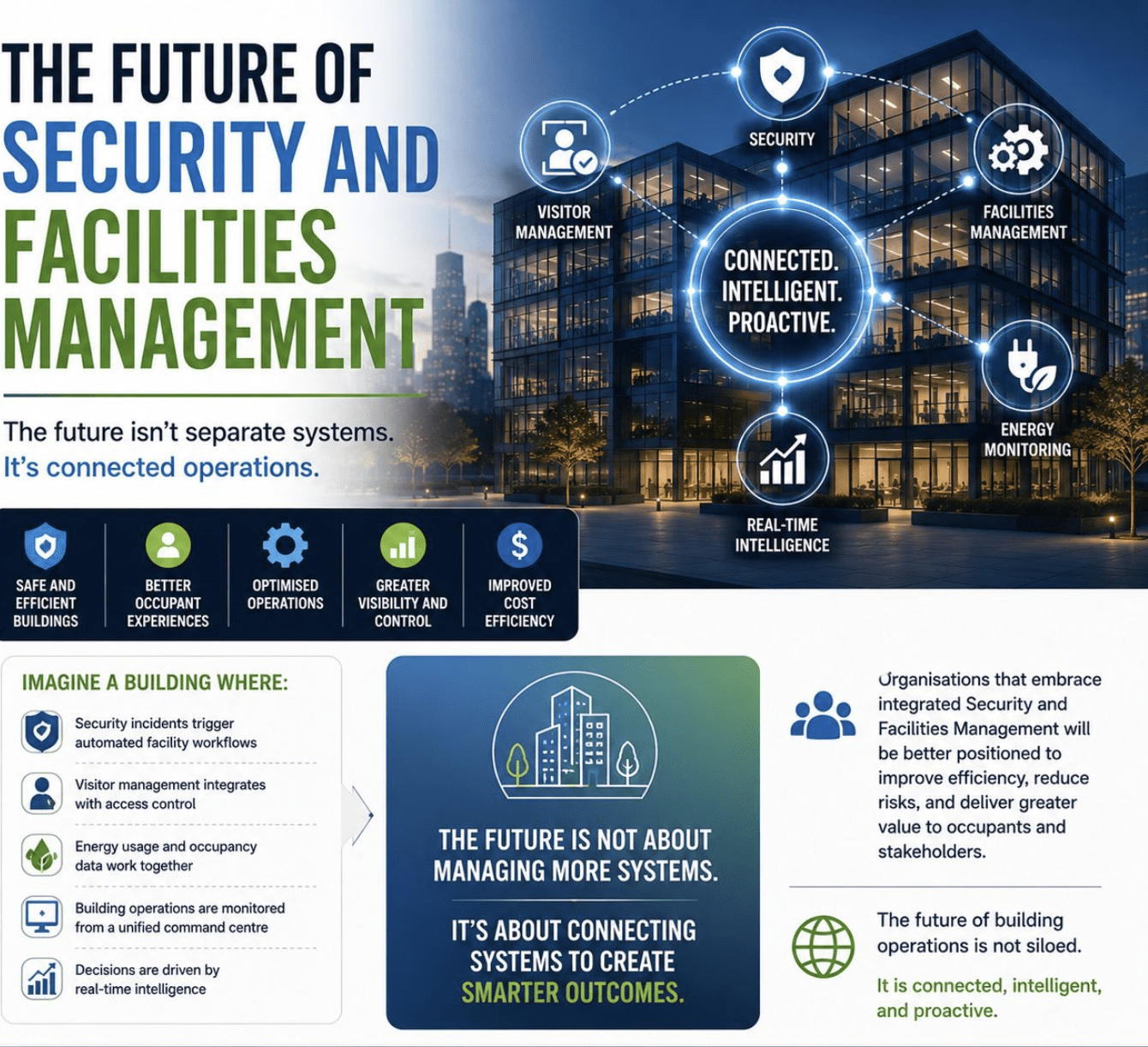
Security and facility operations have traditionally been managed as separate functions.
Security teams may be responsible for:
Facility teams may be responsible for:
However, many operational events affect both functions.
For example:
Connecting relevant information can help teams coordinate more effectively and reduce delays caused by fragmented communication.
An Integrated Facility Management approach brings functions such as maintenance, security, energy management and building operations into a more coordinated environment. This can improve visibility, streamline processes and support more informed operational decisions.
Future ready buildings will not necessarily be defined by the number of technologies installed.
They will be defined by how effectively systems work together to improve outcomes.
Imagine a building where:
The objective is not to remove people from building operations.
Technology should provide employees with better visibility, reduce repetitive work and help them respond more effectively.
The future will move away from isolated systems towards connected operations.
Relevant information may be shared across:
Connected operations can provide a more complete understanding of what is happening across a building.
For example, if a visitor attempts to enter an unauthorised area, relevant information may support:
Instead of managing each activity separately, connected workflows can help the appropriate teams coordinate their responses.
Gabkotech’s Integrated Smart Building Solutions bring security management, facility monitoring, workforce operations and intelligent automation together within a connected ecosystem.
Management should not have to wait until the end of the day to understand what is happening.
Real-time visibility may help authorised personnel monitor:
Real-time information allows teams to identify developing issues earlier and determine what action may be required.
The iREP Facility Management System supports real-time operational insights, building automation, asset tracking, maintenance activities and data-driven facility decisions.
However, greater visibility does not mean displaying every available piece of information.
A useful operational view should help users understand:
What is happening?
What requires attention?
Who is responsible?
What action has been taken?
What remains unresolved?
Automation can help reduce delays and repeated manual work.
For example, a future facility workflow may operate as follows:
Similarly, a security event may trigger:
Automation should not remove human judgement.
Its purpose is to reduce repetitive administrative work and ensure that relevant information reaches the appropriate people more efficiently.
The Smart Facility Management approach supports centralised control, predictive maintenance, energy optimisation and integration with building automation systems.
Connected building systems can generate information about:
However, collecting data is not enough.
Operational information should help management answer practical questions such as:
Data should support management experience and professional judgement.
It should help decision makers identify patterns, evaluate priorities and make more informed choices.
Traditional operations are often reactive.
A security team responds after an incident is reported. A facility team repairs equipment after it fails.
Future operations will increasingly use real-time information and historical patterns to identify risks earlier.
Proactive management may include:
The goal is not to predict every event with certainty.
It is to provide teams with earlier information so they have more time to assess risks and take appropriate action.
Security and facility operations often affect one another.
Consider a damaged external door.
The facility team may need to repair the door. The security team may need to increase monitoring until the repair is completed. Management may need to review whether access was affected.
A connected workflow can help teams understand:
The objective is not to combine every responsibility into one department.
It is to improve the exchange of relevant operational information.
Integrated Facility Management brings multiple facility related services into a more coordinated operating model.
These may include:
Gabkotech’s Integrated Facility Management solution is designed to consolidate facility functions and support automation, real-time monitoring, energy efficiency and improved building performance.
An integrated approach may help organisations:
Integration should simplify operations rather than create additional complexity.
Modern security operations generate information from:
When these systems operate separately, security personnel may need to review several platforms before understanding an event.
A centralised operational environment can help security teams review relevant information and coordinate responses more effectively.
Gabkotech’s GSIMS Smart Command Centre supports centralised monitoring, surveillance integration, AI supported analytics and faster operational response across sites.
Connected security technology should support security professionals rather than replace human judgement.
People remain responsible for verifying information, understanding context, communicating with stakeholders and making appropriate decisions.
Visitor management is an important connection between security, access and occupant experience.
A connected visitor journey may include:
Connecting visitor and access information may help organisations improve:
The objective is to provide a smoother visitor experience while maintaining appropriate security controls.
Energy information becomes more valuable when it is considered together with occupancy, equipment and operational activity.
For example, unusual energy consumption may indicate:
Connecting energy and facility information can help teams understand why consumption has changed and determine whether action is required.
Gabkotech’s GMBA Building Automation Monitoring Tools provide real-time building insights, IoT connectivity, remote monitoring and operational analytics. They can integrate with smart facility and building-management systems to improve energy monitoring and operational efficiency.
Building technology should ultimately support the people who use the building.
Connected security and facility operations may contribute to:
For example, when a facility issue is reported digitally and assigned immediately, occupants may receive a faster response.
When visitor and access processes are connected, guests may experience a smoother arrival.
When energy and building systems respond to operational needs, occupants may experience more comfortable and efficient spaces.
Technology should not be measured only by the number of systems installed.
It should also be measured by whether it improves the experience of building users.
Organisations may already have investments in:
Replacing every existing system may not be practical.
Future-ready building strategies should therefore consider interoperability the ability of relevant systems to exchange information and work together.
Before implementing a new solution, organisations should ask:
Integration should have a clear purpose.
Connecting systems without improving visibility, response or efficiency may add complexity without creating meaningful value.
Artificial intelligence, automation and connected systems can process information quickly.
However, people remain essential.
Security officers, facility managers, technicians and command-centre operators are needed to:
Technology can highlight information and recommend priorities.
Human professionals provide judgement, accountability and leadership.
The future is therefore not simply automated.
It is a partnership between capable people and intelligent technology.
Connecting security and facility operations may help organisations achieve:
Relevant information can reach the appropriate teams more quickly.
Faster responses and more reliable services can improve comfort and confidence.
Connected workflows can reduce repeated administration and improve coordination.
Management can gain a more complete view across security, maintenance, visitors, energy and building operations.
Automation, preventive maintenance and better resource use may help reduce unnecessary operating costs.
Operational information can help management identify patterns and make decisions based on evidence.
Review your current:
Ask:
Begin with workflows where integration can create a clear operational benefit.
Examples include:
Determine:
Integration does not need to happen all at once.
Begin with high priority operational workflows and expand according to business needs.
Monitor whether connected operations improve:
The future of security and facilities management is not about managing more systems.
It is about connecting relevant systems to create smarter outcomes.
Future-ready organisations will increasingly use connected operations to:
The strongest outcomes will come from aligning:
The future of building operations is not siloed.
It is connected, intelligent and proactive.
Gabkotech Innovations provides integrated security, facility and smart-building solutions designed to improve operational visibility, automate workflows and support more responsive building operations.
Explore how Integrated Facility Management, the iREP Facility Management System, Integrated Smart Building Solutions and Smart Facility Management can support safer, smarter and more connected buildings.
REQUEST A CONSULTATION OR PRODUCT DEMONSTRATION



















26 Sin Ming Lane, #05-127 Midview City, Singapore (573971)
No. 47A, Jalan Indah 16/12, Taman Bukit Indah, 79100, Iskandar Puteri, Johor