
Blog Post Published on: July 13, 2026, by Gabkotech
Managing one construction site is demanding. Managing several sites simultaneously can be even more challenging.
Construction managers, project directors, safety teams and operations personnel must know what is happening across different locations—even when they cannot physically be present at every site.
Questions can arise throughout the day:
When these answers are scattered across telephone calls, messaging groups, paper records and spreadsheets, management may only discover a problem after it has already affected operations.
This is the construction site visibility gap.
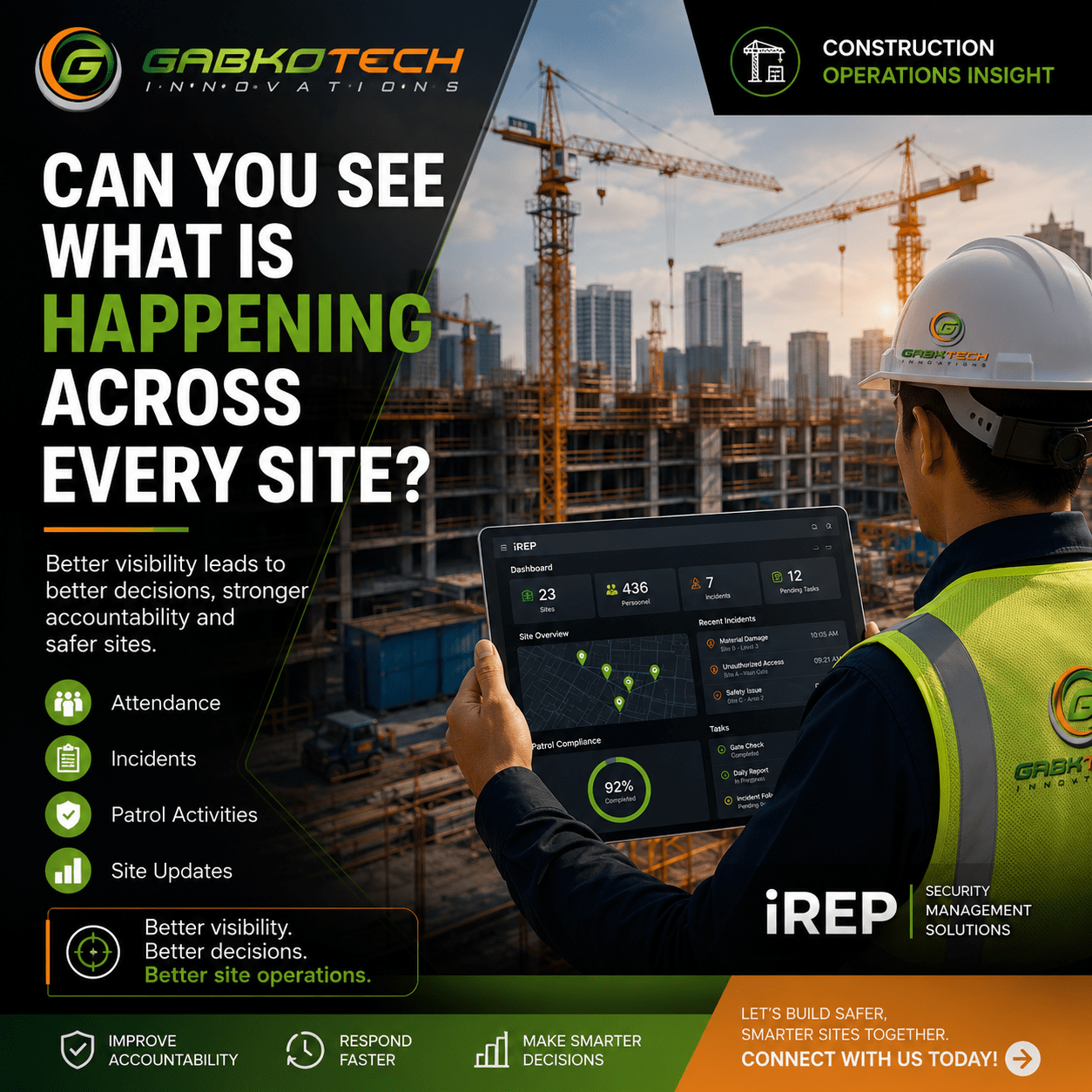
Construction site visibility refers to management’s ability to access reliable and timely information about activities taking place at a project site.
It includes visibility over:
Effective visibility is not simply about receiving more information. It is about receiving the right information, from the right location, at the right time.
A centralised digital platform such as the iREP Security Management System can bring attendance, patrol, incident and other operational records into a more unified management environment. Gabkotech describes iREP as supporting functions including clocking, attendance tracking, emergency alerts, manpower rostering and digital operational records.
Many construction operations still depend on fragmented reporting methods.
A supervisor may send an update through a messaging application. Attendance may be recorded in a spreadsheet. An incident may be written in a physical logbook. Photographs may be stored on an individual employee’s telephone.
Each method may work independently, but together they can create several problems.
A delay of even a few hours can affect how quickly an organisation reacts to an incident, missing worker or unresolved site issue.
A written message saying that an inspection was completed may not provide sufficient evidence of when, where or by whom it was performed.
When several employees report the same event through different channels, important facts may be omitted or misunderstood.
Paper forms and messaging conversations are difficult to search when management needs records for investigations, client reporting, audits or internal reviews.
Without standardised reporting, management cannot easily compare attendance, incidents, patrol completion or outstanding work across projects.
Construction projects depend on workers, subcontractors, supervisors, security officers and other site personnel reporting at the correct location and time.
Manual attendance records may tell management who was scheduled to work, but not always who actually arrived.
A real-time attendance system can provide better visibility by recording attendance digitally and incorporating technologies such as GPS and NFC verification. Gabkotech’s iREP Attendance System is designed to give management remote visibility of who is on duty and provide time and location evidence for attendance records.
This can help construction managers:
Real-time attendance information does not replace site supervisors. It gives supervisors and management more dependable information upon which to act.
Construction sites are dynamic environments. Equipment faults, unauthorised access, safety concerns, damaged property and operational disruptions may occur with little warning.
The effectiveness of the response often depends on how quickly the incident is recorded, communicated and assigned.
With a digital incident reporting system, authorised site personnel can submit incident details, photographs and other evidence through a mobile device. Relevant stakeholders can then receive notifications and follow the incident through a central dashboard.
Gabkotech’s Incident Report Software supports mobile reporting, evidence uploads, alerts, audit trails and reporting dashboards for tracking incident trends and response performance.
This improves construction site visibility by showing management:
Instead of repeatedly asking for updates, management can view the status directly.
Security and operational patrols are important for identifying unauthorised access, unsafe conditions, unsecured areas and other site irregularities.
However, management needs more than a handwritten statement confirming that a patrol was completed.
The iREP Clocking and Patrolling System uses mobile and NFC-enabled checkpoint recording to provide digital evidence of patrol activities. It can also support incident reporting and alerts for missed or incomplete patrols.
Verified patrol data allows management to see:
This creates a stronger chain of accountability across the construction site.
A supervisor may oversee several workers, security officers or operational areas. If supervisory inspections are recorded only in paper books, management may have difficulty confirming whether checks were completed correctly.
The iREP Security Supervisory Check System digitises site inspections through NFC checkpoints, mobile checklists, photographs and digital acknowledgement.
For construction operations, this approach can support checks involving:
Supervisory information becomes accessible to management without waiting for a physical inspection book to reach the office.
Construction instructions can change quickly. An access point may be closed, a delivery schedule may be revised or personnel may need to follow a new procedure.
Sending information is only part of the process. Management may also need assurance that the intended personnel received and read the instruction.
The iREP E-Announcement System allows messages to be sent to selected groups and tracks acknowledgements, helping management confirm that important updates have been received.
This is especially helpful when the same announcement must reach personnel working across several sites or shifts.
During an emergency, calling individual employees or searching through messaging groups can slow down coordination.
An integrated emergency alert system can send notifications to relevant stakeholders and provide digital procedures or checklists for the response team.
Gabkotech’s iREP Emergency Alert System supports real-time notifications, digital checklists and multi-channel alerts to help facilities and operations teams respond more quickly.
For construction sites, this can support more coordinated communication during:
When a construction company operates several projects, management should not have to contact every site individually before obtaining an operational overview.
A centralised dashboard can consolidate information from different locations and present it in a consistent format.
Management may then compare:
For more complex environments, the Gabkotech Security Integrated Management System provides command-centre capabilities involving centralised monitoring, surveillance and analytics.
This gives senior management a broader operational picture rather than a collection of disconnected reports.
Real-time visibility is valuable only when the information helps management make better decisions.
For example, centralised data may reveal that:
These patterns may be difficult to identify from individual paper reports. A digital platform makes it easier to review information over time and decide where corrective action is needed.
After an important incident, the iREP After Action Review System can also help teams document lessons, identify operational gaps and connect improvement recommendations to incident records.
When operational information is timely, standardised and accessible, construction organisations can achieve several improvements.
Every update can be linked to a person, time, location and supporting evidence.
Management receives information earlier and can assign follow-up actions more quickly.
Different sites follow the same digital workflow and reporting format.
Project owners and relevant stakeholders can receive clearer, more organised operational information.
Managers can identify patterns and allocate manpower and resources based on actual data.
Information remains available within the company system instead of being stored on individual devices or in physical books.
Digital transformation does not need to begin with every process at once.
Construction companies can start by identifying the areas that currently create the greatest uncertainty:
The organisation can then digitise the most urgent workflow before progressively connecting additional operational functions.
The objective is not to collect data for its own sake. The objective is to provide management with reliable information that supports faster action, stronger accountability and safer, better-managed sites.
Construction leaders cannot be physically present at every site throughout the day. However, they should still be able to see whether essential activities are being completed.
By centralising attendance, incident reports, patrol activities, supervisory checks and operational updates, iREP helps management gain a clearer view of site performance.
Build safer, smarter and more accountable construction operations with Gabkotech Innovations.
Discover how iREP can help your organisation centralise site information, improve accountability and respond faster across multiple construction projects.
Contact Gabkotech Innovations to request a consultation or product demonstration.





















26 Sin Ming Lane, #05-127 Midview City, Singapore (573971)
No. 47A, Jalan Indah 16/12, Taman Bukit Indah, 79100, Iskandar Puteri, Johor