
Blog Post Published on: June 26, 2026, by Gabkotech
Every building generates operational information throughout the day.
Security incidents are reported. Visitors enter and leave. Alarms are activated. Equipment develops faults. Maintenance requests are submitted. Patrols and inspections are completed or missed.
Yet having information does not automatically mean that management has visibility.
When updates are scattered across paper records, spreadsheets, messaging groups and disconnected systems, decision-makers may only discover an issue after it has already disrupted operations.
Real-time operational intelligence changes this.
It gives authorised personnel access to relevant, current and actionable information so that they can understand what is happening, determine what requires attention and respond before a small issue becomes a larger problem.
The right information is valuable. But the right information at the right time can change the outcome.
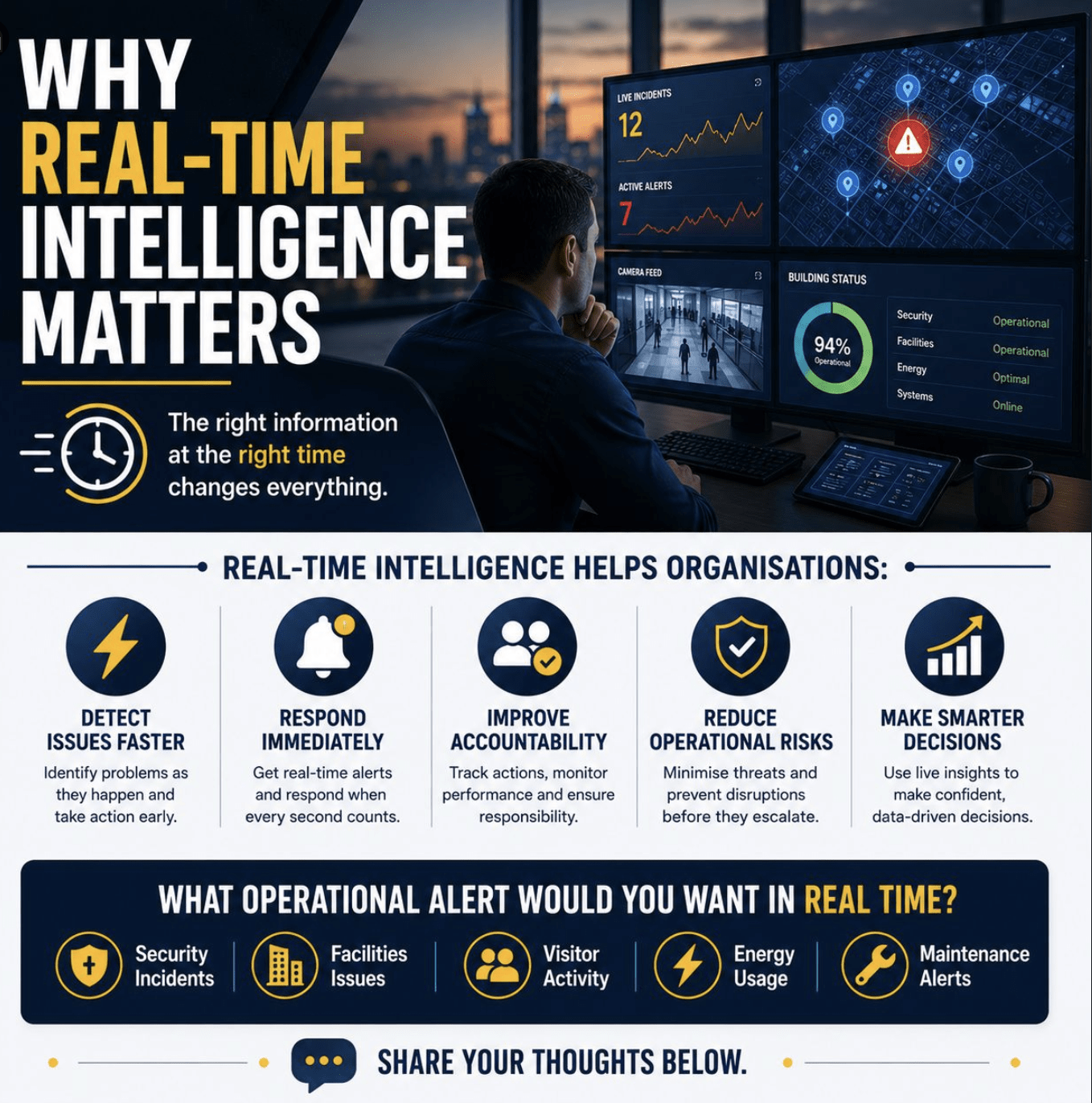
Real-time operational intelligence is the ability to collect, organise and present current operational information in a way that supports immediate awareness and action.
This information may come from:
Operational intelligence goes beyond displaying raw figures.
It should help management answer practical questions such as:
Gabkotech’s Smart Command Centre powered by GSIMS integrates real-time monitoring, video analytics, automated alerts and multi-site information within a unified operational environment. It is designed to help security teams gain centralised visibility and coordinate faster responses.
An operational update can be accurate but still arrive too late to be useful.
For example, an end of day report may confirm that an unauthorised visitor entered a restricted area, an equipment alarm was activated or a patrol checkpoint was missed.
The report explains what happened, but it may no longer allow management to prevent the immediate consequences.
A minor equipment fault may become a service disruption.
A suspicious activity may develop into a security incident.
A missed maintenance task may affect occupant comfort or building safety.
When employees must call several departments or search through different messaging groups, the response process can be delayed.
Management may struggle to determine when the issue was reported, who received the information and whether anyone was assigned to act.
When security, facilities and visitor information are held separately, each department may see only one part of the situation.
Real-time intelligence creates a more complete and current operational picture.
Early detection gives organisations more time to assess and manage a developing situation.
Real-time systems can help identify:
The Advanced Video Analytics system uses AI-powered analysis to identify events such as intrusions, loitering and unusual activities, helping security teams turn live video into actionable information.
Technology does not remove the need for human assessment. It directs the operator’s attention to events that may require verification and action.
Detecting an issue is only the first step.
The information must also reach the correct personnel quickly.
A structured real-time workflow can show:
The iREP Emergency Alert System supports real-time notifications, digital checklists and multi-channel alerts to help organisations communicate and coordinate emergency actions more efficiently.
Instead of relying entirely on phone calls and separate messages, relevant personnel can receive the same information through a more organised process.
Real-time intelligence makes operational activities more visible and traceable.
Digital records can show:
The iREP Incident Report System supports real-time digital reporting, evidence capture and dashboard analytics, allowing incidents to be recorded and monitored through a structured system.
This helps replace uncertain verbal updates with clearer operational records.
Real-time visibility allows management to address developing problems before they cause greater disruption.
For example, an organisation may receive alerts about:
Earlier awareness does not guarantee that every incident can be prevented. However, it gives management a better opportunity to intervene, reduce the impact and prevent further escalation.
Gabkotech’s Virtual Patrol solution powered by GSIMS combines CCTV, sensors and video analytics to support real-time monitoring, incident detection and automated alerts from a central command environment.
Real-time intelligence supports both immediate and long-term decision-making.
During an active event, management can decide:
Over time, operational information can also reveal:
The objective is not to display more data. It is to present information that helps management make timely and confident decisions.
Security teams often manage large amounts of information from cameras, alarms, incidents, access systems and physical patrols.
When these sources operate separately, command-centre personnel may need to switch between several screens before understanding what is happening.
The Gabkotech Security Integrated Management System GSIMS supports centralised security monitoring, rapid threat detection and AI analytics across multiple cameras and operational sources.
A connected security workflow may operate as follows:
This helps security teams move from passive observation to faster and more coordinated action.
Building operations involve more than security.
Facility managers must also monitor assets, maintenance activities, equipment conditions, compliance requirements and service requests.
The iREP Facility Management System provides tools for maintenance scheduling, asset tracking, energy monitoring and compliance reporting. Gabkotech describes the platform as supporting real-time monitoring and data-driven facility decisions.
Real-time facility intelligence can help management identify:
This supports a shift from reactive maintenance towards more preventive and predictive facility management.
A building incident does not always belong to only one department.
For example:
The Integrated Facility Management approach brings multiple facility functions into a unified management structure, including maintenance, energy management, security, access control and IoT-enabled performance tracking.
Connecting relevant security and facility information gives management a more complete view of how one issue may affect the wider building operation.
Visitor activities can also influence security and building operations.
Management may need to know:
Gabkotech’s Visitor Management System supports pre-registration, contactless check-in, host notifications, real-time visitor tracking and blacklist alerts.
When visitor information is connected with security and access workflows, front-desk and security personnel can respond more effectively to access-related concerns.
Energy and building-system information can provide early indications of operational issues.
For example, unusual consumption may indicate:
However, real-time energy data is useful only when someone can interpret it and act on it.
Energy information should therefore be connected to facility-maintenance processes rather than simply displayed as another dashboard figure.
The iREP Facility Management System includes energy monitoring and building automation capabilities that can help facility managers identify patterns and improve resource management.
Real-time data and real-time intelligence are related, but they are not identical.
Real-time data tells management what is currently being recorded.
Examples include:
Real-time intelligence provides context and helps determine what action may be required.
For example:
A system becomes more useful when it helps people understand priorities rather than only presenting more information.
An effective dashboard should focus on operational priorities rather than overwhelming users with every available figure.
Depending on the organisation, it may show:
The Smart Command Centre powered by GSIMS integrates CCTV, video analytics, access control, licence-plate recognition, visitor management and smart facility systems within one platform.
A dashboard should help users recognise:
Real-time systems can detect events, organise information and distribute alerts, but they should not operate without human oversight.
People are still needed to:
Not every alert represents a genuine emergency.
A human operator may need to review camera footage, contact the site or investigate supporting information before escalating an event.
The strongest model combines the speed of technology with human judgement and accountability.
Reactive management waits for a problem to be reported.
Proactive management uses live information and historical patterns to address risks earlier.
Consider a building where the same equipment alarm is activated repeatedly.
A reactive approach resets the alarm each time.
A proactive approach examines:
Following a significant incident or operational disruption, the iREP After Action Review System can help teams document observations, identify lessons and record improvement recommendations.
Real-time intelligence supports immediate action, while review and analysis help prevent repeated failures.
Installing technology alone does not guarantee better operational outcomes.
CCTV, access control, visitor management, maintenance and incident reporting may use separate platforms.
Management should identify which systems need to exchange information.
If every event generates the same level of notification, operators may become overwhelmed.
Alerts should be categorised and prioritised according to severity.
Incomplete or inaccurate information can lead to incorrect conclusions.
Digital forms and operational procedures should capture consistent data.
An alert is not useful if no one knows who should respond.
Each type of event should have a defined owner, workflow and escalation process.
Security officers, facility teams, supervisors and command-centre operators must understand how to use the system correctly.
Organisations should determine who can view operational information, how long data is retained and how personal information is protected.
Begin with questions such as:
Review where your data currently comes from:
Start with workflows where delayed information creates the greatest operational risk.
These may include emergency alerts, incident escalation, equipment alarms and unauthorised access.
Establish:
Give authorised users a common dashboard showing the issues that require their attention.
Measure:
Use these findings to improve procedures, deployment and system configuration.
Buildings are becoming more complex, and management teams are expected to oversee more systems, sites and operational responsibilities.
Relying only on end of day reports and fragmented updates limits an organisation’s ability to respond effectively.
Real-time operational intelligence helps organisations:
The objective is not simply to collect more data.
It is to turn relevant information into timely, responsible action.
Would it be:
The answer may be different for every organisation.
The important question is whether the people responsible for responding can receive the information while it is still useful.
Gabkotech Innovations provides integrated security, facility and building management solutions that help organisations centralise information, improve response coordination and gain greater visibility across multiple sites.
Explore how the Smart Command Centre powered by GSIMS, iREP Incident Report System, iREP Emergency Alert System and iREP Facility Management System can support more responsive and connected operations.
REQUEST A CONSULTATION OR PRODUCT DEMONSTRATION

















26 Sin Ming Lane, #05-127 Midview City, Singapore (573971)
No. 47A, Jalan Indah 16/12, Taman Bukit Indah, 79100, Iskandar Puteri, Johor