
Blog Post Published on: June 24, 2026, by Gabkotech
Security operations generate large amounts of information every day.
Incident reports, patrol records, visitor entries, alarm activations, attendance records, video feeds and supervisory inspections can all provide valuable insights into how effectively a site is being protected.
However, collecting information is not the same as using it effectively.
When operational data remains scattered across paper logbooks, spreadsheets, messaging groups and separate security systems, management may struggle to understand what is really happening across its sites.
Data-driven security management changes this by turning day-to-day security information into structured, accessible and actionable insights.
Instead of using records only to explain what has already happened, security teams can use data to identify recurring problems, improve officer productivity, respond more quickly and reduce risks before they escalate.
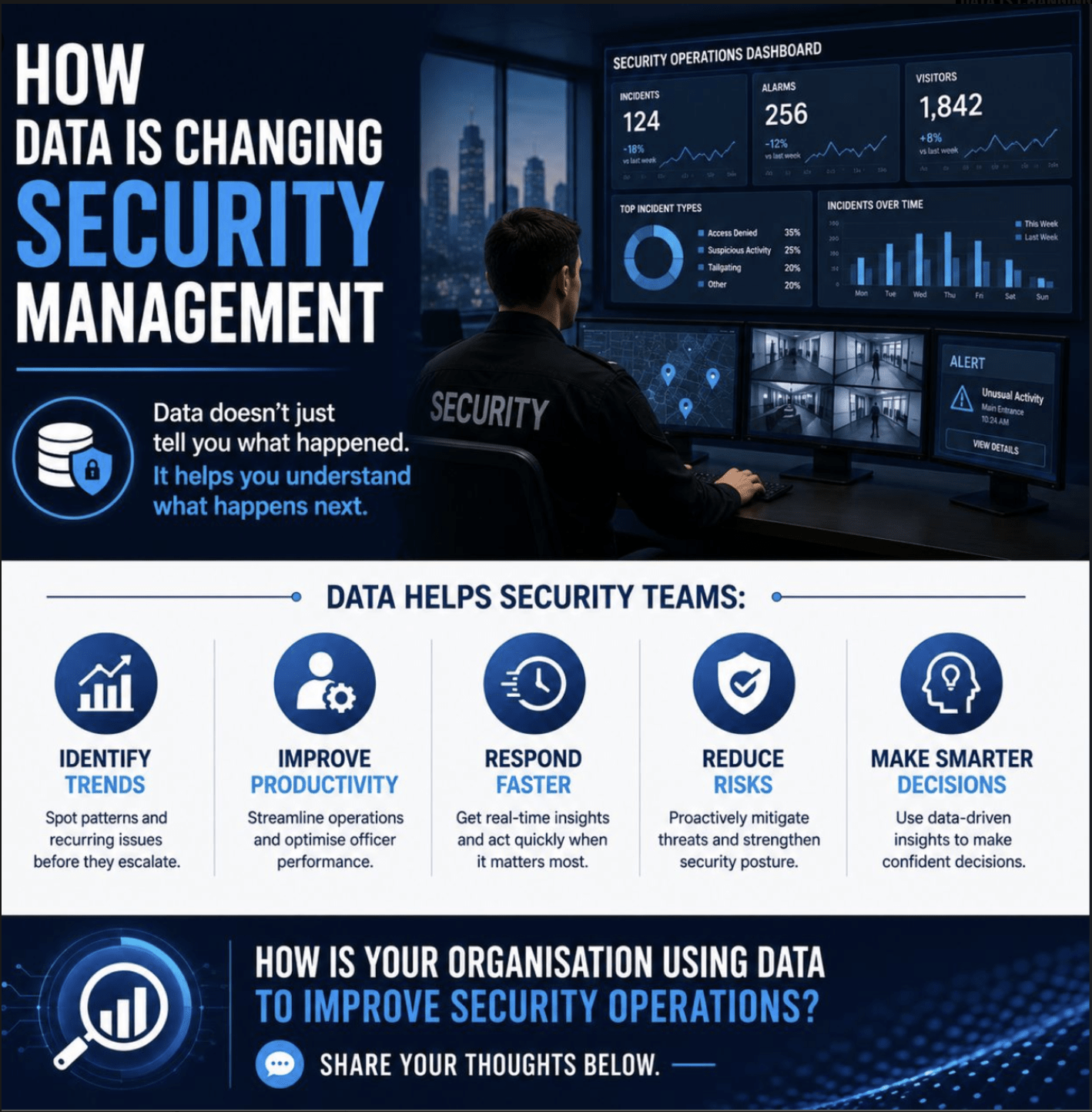
Data-driven security management is the use of reliable operational information to guide security planning, deployment, response and continuous improvement.
It involves collecting and reviewing information from areas such as:
A connected system can help management understand not only individual events but also patterns across different locations, teams and time periods.
Gabkotech’s iREP Security Management System provides a centralised environment for security-related workflows such as incident reporting, patrol management, attendance, visitor management and emergency alerts. This gives authorised management teams access to operational information that can support faster, data-informed decisions.
Traditional reporting often focuses on recording an event after it has happened.
An officer writes an incident report, a supervisor reviews a physical logbook or an operations manager receives a spreadsheet at the end of the week.
These records may still be useful, but several limitations can prevent management from gaining meaningful insights.
Incident reports may be kept in one system, patrol records in another and attendance records in a spreadsheet.
Management must then collect information from several sources before understanding the complete situation.
When reports are submitted only at the end of a shift or reporting period, management may lose the opportunity to intervene early.
Paper records and unstructured messages make it difficult to compare incidents across sites, identify patterns or measure changes over time.
One incident may appear isolated. However, when several incidents occur repeatedly at the same location or during the same shift, the pattern may reveal a larger operational weakness.
Without a centralised workflow, management may find it difficult to confirm who was assigned to resolve an issue and whether the matter was closed.
Greater visibility means giving authorised decision-makers a timely and reliable view of what is happening across security operations.
A dashboard may show:
For organisations managing several buildings or sites, this information can reduce the need to contact each location individually for updates.
The Gabkotech Security Integrated Management System (GSIMS) uses centralised monitoring and AI-supported analytics to examine video feeds and operational data, identify potential security events and generate alerts for the command centre.
A single report explains one event. A collection of structured reports can reveal a recurring pattern.
Security teams may discover that:
The iREP Incident Report System allows security and facility personnel to record incidents digitally, upload supporting evidence and monitor resolution status. Its analytics dashboard can also help management examine incident trends, response times and areas of concern.
When incidents are categorised consistently, management can move beyond individual reports and begin identifying root causes.
Security productivity should not be measured only by the number of officers deployed.
Management also needs to understand whether essential duties are being completed efficiently and consistently.
Operational data can help managers review:
The iREP Clocking and Patrolling System records checkpoint scans and patrol activities digitally, enabling management to verify officer presence, review patrol completion and access records remotely.
Data should not be used simply to penalise employees. It should help management identify where officers need clearer procedures, better tools, additional training or improved deployment.
During an incident, delays in communication can increase operational risk.
Security personnel must be able to report what happened, provide evidence and notify the relevant stakeholders without waiting for several layers of manual communication.
A structured incident workflow can show:
The iREP Emergency Alert System supports real-time communication through mobile and web access, multi-channel notifications and digital response checklists. Its common-view dashboard helps management assess an incident and coordinate actions more quickly.
Real-time information helps the appropriate people act on an issue while it is still developing rather than discovering it in an end-of-day report.
Historical information can help organisations understand where future risks may arise.
For example, data may reveal:
When these patterns become visible, management can consider preventive measures such as changing patrol routes, improving procedures, adjusting deployment or strengthening monitoring.
Gabkotech’s Advanced Video Analytics system uses AI to analyse video footage for events such as intrusion, loitering and unusual activities. The system is designed to turn raw video into actionable information and help security teams improve situational awareness and response.
Technology should support the security team’s judgement rather than replace proper investigation and human oversight.
Security decisions are stronger when they are supported by evidence.
Instead of relying only on assumptions or isolated feedback, management can review actual operational information before deciding whether to:
The Smart Command Centre powered by GSIMS integrates monitoring, analytics, alerts and multiple security systems within one platform. It can provide multi-site visibility and help operators prioritise incidents requiring attention.
The objective is not to produce more dashboards. It is to give management the information needed to make timely and confident decisions.
A security dashboard brings relevant information together in a visual format.
Instead of reviewing numerous individual reports, management can see selected indicators at a glance.
Useful dashboard information may include:
However, a dashboard should not display information simply because the data is available.
The information should be relevant to a specific operational question.
For example:
Are response times improving?
Which locations have repeated incidents?
Are patrols being completed as scheduled?
Which unresolved issues need management attention?
Are some sites experiencing significantly more alarms than others?
A useful dashboard helps management move from looking at figures to taking action.
Incident reporting should not end when a case is marked as closed.
Every significant incident can provide information about what worked, what did not work and what should be improved.
Management can review:
The iREP After Action Review System connects with incident reporting and allows teams to record observations, lessons and recommendations following incidents, exercises or operations. This supports a continuous improvement process rather than treating every event as an isolated case.
Video surveillance produces a large amount of information, but much of that information may remain unused unless an operator notices an event or reviews the footage later.
Combining video analytics with incident and operational information can improve its value.
For example:
The Virtual Patrol solution powered by GSIMS connects CCTV, sensors and video analytics to provide automated surveillance, alerts and centralised monitoring. It can complement physical patrols by helping the command centre identify events requiring human attention.
This creates a more complete workflow than operating cameras, patrols and incident reporting independently.
Supervisory inspections provide another valuable source of operational information.
Digital inspection records can help management understand:
The iREP Security Supervisory Check System allows supervisors to complete mobile inspections, submit photographs and synchronise records to a web dashboard. Management can then review performance and export reports for operational or client purposes.
When supervisory information is reviewed together with incident and patrol data, management gains a more complete picture of site performance.
Reactive security management begins after an event occurs.
Proactive security management uses information to identify weaknesses and take preventive action earlier.
Consider this example:
A site reports three unauthorised access incidents within one month.
A reactive approach handles each incident separately.
A data-driven approach examines:
Management can then decide whether it needs to change a procedure, strengthen access controls, increase monitoring or adjust deployment.
Data does not predict every incident with certainty. However, it can help organisations recognise warning signs and make better-informed preventive decisions.
Data-driven security management is not achieved simply by installing software.
Organisations must also address several practical challenges.
Incomplete, duplicated or incorrectly categorised records can produce misleading conclusions.
Digital forms should therefore be designed to capture consistent and relevant information.
Collecting more data does not automatically create better insights.
Management should define which information supports meaningful decisions.
Incident reporting, CCTV, visitor management and access control may operate separately.
Integration can help relevant information move between systems and teams.
Even a strong platform will produce poor results if users do not enter information properly.
Officers, supervisors and managers need clear processes and appropriate training.
Security information may include personal or operationally sensitive data.
Organisations should establish clear rules concerning data collection, retention, authorised access and responsible use. Gabkotech’s privacy policy states that data may be collected through platforms such as visitor systems, CCTV, video analytics and integrated security systems, and used for security, safety and compliance monitoring where permitted.
Begin with practical management questions.
For example:
Use consistent categories, digital forms and reporting procedures across sites.
Bring information from incidents, patrols, alerts and inspections into an accessible management environment.
Measure indicators connected to operational outcomes, such as:
Data should form part of weekly and monthly operational reviews rather than being examined only after a serious incident.
Assign responsibility for each improvement, establish a deadline and review whether the action produced a better outcome.
The value of security data is not determined by the number of reports collected.
Its value comes from what the organisation learns and improves.
Useful security data should help management:
When incident reporting, patrol activities, alerts, video analytics and supervisory checks are connected, security teams can move from fragmented reporting towards a clearer and more proactive management approach.
Security professionals will continue to provide judgement, communication, physical response and leadership.
Technology strengthens these capabilities by organising information and highlighting patterns that may otherwise remain hidden.
The future is not about allowing data to make every decision automatically.
It is about giving experienced security personnel better information so they can make better decisions.
Organisations that use security information effectively can gain:
Data should not simply tell security teams what happened.
It should help them understand why it happened, what is changing and what should happen next.
Gabkotech Innovations provides integrated security solutions that help organisations centralise operational information, improve incident reporting, monitor patrol activities and gain clearer visibility across multiple sites.
Explore how the Gabkotech Security Integrated Management System, Smart Command Centre, iREP Security Management System and Incident Report System can support more informed security decisions.
















26 Sin Ming Lane, #05-127 Midview City, Singapore (573971)
No. 47A, Jalan Indah 16/12, Taman Bukit Indah, 79100, Iskandar Puteri, Johor