
Singapore’s security industry plays a critical role in safeguarding commercial buildings, residential developments, industrial facilities, educational institutions, and public infrastructure. However, the industry is facing increasing pressure from rising operational demands, higher client expectations, and a shrinking workforce.
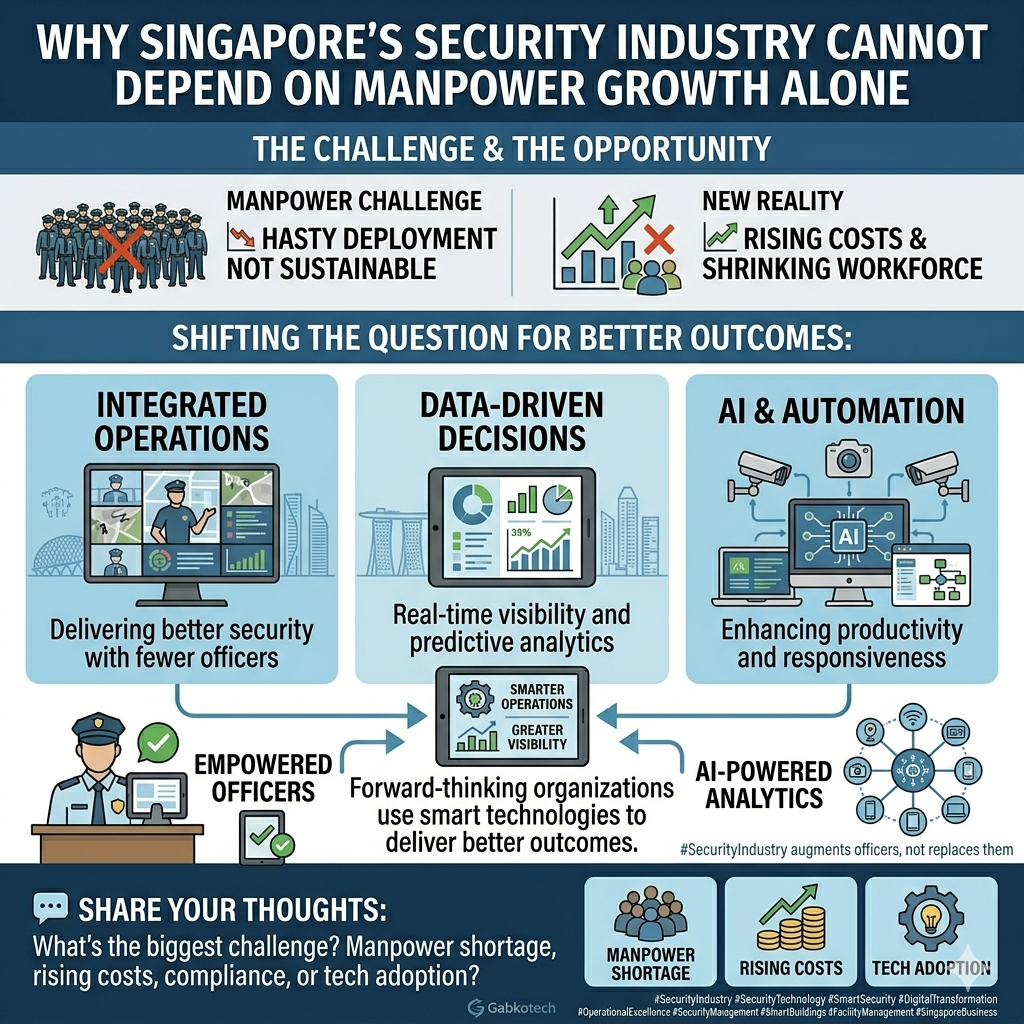
For many years, the common response to growing security requirements was straightforward: deploy more officers. While this approach may have worked in the past, today’s environment presents a different reality. Labour shortages, increasing wage costs, and the growing complexity of security operations mean that simply adding more manpower is no longer a sustainable strategy.
The question is no longer, “How can we hire more officers?” Instead, forward-thinking organisations are asking, “How can we deliver better security outcomes with the resources we already have?”
The security industry is experiencing significant manpower challenges. Recruitment has become increasingly difficult as the workforce ages and fewer younger workers enter the industry. At the same time, demand for security services continues to grow across commercial, residential, healthcare, education, and critical infrastructure sectors.
As labour supply tightens, wages continue to rise. Security agencies are under pressure to attract and retain qualified officers while maintaining profitability and meeting service level expectations.
This creates a difficult situation:
Clients expect higher levels of service.
Operating costs continue to increase.
Manpower resources remain limited.
Relying solely on manpower growth creates a cycle that is increasingly difficult to sustain.
Security operations today involve much more than guarding physical premises. Security teams are expected to manage:
Incident reporting
Visitor management
Access control
Patrol management
Compliance requirements
Emergency response coordination
Multi-site operations
As organisations expand, supervisors and operations teams often find themselves managing dozens of sites simultaneously. Without the right systems, this can lead to delayed responses, fragmented information, and reduced operational visibility.
Simply adding more officers does not solve these operational challenges.
Across Singapore, organisations are increasingly adopting integrated approaches to security management. Rather than operating as isolated sites, security operations are becoming connected through digital platforms that provide real-time visibility across multiple locations.
Integrated operations enable management teams to monitor incidents, manpower deployment, patrol activities, and operational performance from a single dashboard.
This shift allows supervisors to focus on decision-making rather than spending valuable time gathering information from multiple sources.
Modern security operations are becoming increasingly data-driven. Instead of relying solely on manual reports and historical observations, organisations are using operational data to identify trends, measure performance, and improve decision-making.
Examples include:
Incident trend analysis
Site performance monitoring
Resource utilisation tracking
Risk identification and forecasting
Compliance monitoring
Data provides insights that help organisations proactively manage risks rather than reacting after issues occur.
Artificial Intelligence and automation technologies are also becoming more common across the security sector. These technologies are not intended to replace security officers. Instead, they are designed to support and empower the workforce.
Examples include:
Automated incident reporting
Intelligent alert management
Video analytics
Predictive risk identification
Automated workflow management
By reducing repetitive administrative tasks, officers can focus on higher-value responsibilities that require human judgement and experience.
Organisations should consider adopting integrated security management platforms that consolidate operational data into a single view.
Benefits include:
Real-time operational visibility
Faster incident response
Improved accountability
Better resource allocation
Enhanced management oversight
Integrated operations help organisations achieve more without simply increasing headcount.
Security leaders should move beyond manual reporting and begin leveraging operational intelligence.
By collecting and analysing data from daily operations, organisations can:
Identify recurring issues
Improve workforce productivity
Optimise site deployment
Measure service performance
Make informed business decisions
Data-driven management enables continuous improvement and more effective use of available resources.
Technology should be viewed as a force multiplier rather than a replacement for manpower.
Tools such as:
Mobile incident reporting
Digital patrol management
Workforce management systems
Smart command centres
Real-time communications platforms
allow officers to work more efficiently while improving service quality and accountability.
The future security officer will not work alone. They will be supported by technology that enhances situational awareness, productivity, and decision-making.
AI can assist organisations in processing large amounts of information, identifying patterns, and generating actionable insights.
When implemented responsibly, AI can help security teams:
Detect anomalies faster
Improve response times
Reduce administrative workloads
Enhance operational planning
The goal is not to replace people but to augment human capabilities and improve overall operational effectiveness.
Singapore’s security industry is entering a new era. Rising costs, manpower shortages, and increasing operational complexity mean that traditional manpower-driven approaches are becoming less effective.
The organisations that will succeed in the years ahead are not necessarily those with the largest workforce. They will be those that combine people, processes, and technology to achieve better outcomes.
Integrated operations, data-driven decision-making, automation, and AI are no longer future concepts they are practical tools that can help organisations improve efficiency, strengthen security performance, and create sustainable growth.
The future of security is not about deploying more officers. It is about empowering officers with the technology and intelligence they need to deliver better results.
As the industry continues to evolve, the key question is no longer whether technology should be adopted, but how quickly organisations can embrace it to remain competitive and effective.



















26 Sin Ming Lane, #05-127 Midview City, Singapore (573971)
No. 47A, Jalan Indah 16/12, Taman Bukit Indah, 79100, Iskandar Puteri, Johor